SNS KASHMIR
SRINAGAR FEBRUARY 15 :
A A Latief u zaman Deva
When the two core constituents of the Constituency of the despotic reign found themselves incapable of outpacing the ‘’Ghar Mulkies” in the recruitments against the posts in the State of J&K, they launched agitation for protections in services in favour of ‘’Mulkies” which later on resulted in issuance of a Notification in 1927 defining thereunder the ‘’State Subjects ‘’. The indigenization didn’t provide reprieve to the locals from corruption and red- tap but instead the whole bureaucracy along with the lower rung officials was highly coercive, arrogant & steeped in unprecedented corruption and inefficiency. Once the other stakeholders started claiming share in the jobs the protectionists became overnight the champions of non- discriminatory selection processes which remained in general elusive due to exercise of appointment powers by the political executives from time to time with seldom bouts of selections through independent institutions . It is only from 1968 onwards we find the State attempting to have a recruitment system devoid of interference from the Govtt which by now is perfectly transparent and merit based. Unfortunately owing to the past hangovers, while the general public is vying for merit based recruitments, some characters expect share on ethnic & linguistic basis which is impossible to fructify unless the system as a whole collectively degenerates, a rarest of rare possibility in contemporary times Where the persons charged with the assignments are generally fiercely opposed to manipulations. The demands for uncodified selections representing ethnic and chauvinistic foot prints runs counter to the concept of’’ Nation & Nationality’’ being espoused in political discourses by the same coterie and therefore its adherents should bury once & for all the pernicious debate affecting adversely the inter communal & linguistic harmony.
Under the J&K Reservation Act 2004 & J&K Reservation Rules 2008 as amended up to date the percentage of reservations for Scheduled castes(SC) is 8%, Scheduled Tribes (ST)10%, Residents of Backward Areas(RBA) 10%, Residents of line of Actual Control and International Boarders(LOC/IB) 4% ,Other Social Castes(OSC) 4% & Pahari Speaking Persons (PSP) 4%. Out of the entire SC population 85% is inhabiting in the Distts of Udhampur, Jammu, Samba and Kathua & Reasi sub-Division with remaining spread over the rest of Jammu Division,68% STs, 72% PSPs & 93 % LOC residents are domiciled in Jammu Division.It is only in the case of RBAs & OSCs who are near evenly dispersed across the UT which is manifested by their being respectively 53% & 50 % in Kashmir Division. The population covered under categories listed above is 62.86% of total UT population and out of the said Segment 63.20 % fall in Jammu Division.
Unprincipled apportionment.
The reservations at national level for SCs, STs & OBCs is proportionate to their respective population and accordingly in recruitment to central services & admissions in the central universities/ national institutions the reservation for these three categories is respectively 15%,07.5% & 27% in proportion to their populations. In J&K the percentage of the population of SCs, STs, RBAs, persons on LOC , OSCs, & PSPs is 8%,10%, 30%, 3.24%, 03% & 8% respectively but while all categories have got share perfectly in accordance with their population or more than the population it is unfortunate that the Segments like Pahari and RBAs have countenanced the scissors for denying them of their due share as the former have suffered 50% reduction & latter 2/3rd . Due to non availability of Data about population living within permissible limits of international Boarder the analysis remains confined to LOC only which shall however further undergo changes on its availability enhancing the percentage of LOC population in Jammu Division for obvious reasons and it is for this reason the reservation for the said category is 4% instead of 3.24 %. OSC apparently has in excess got the share unless additional castes stand included in recent times. The strict jackets of proportionate share would have exceeded the limit of 50% capped by the Apex Court for reservations but in absence of any socio- economic analysis the RBAs & PSPs only have been singled out for award of 10% & 4% instead of 30% & 8% respectively. Excepting any dilution in the case of constitutionally mandated reservations for SCs and STs the principle of reduction in the shares for remaining four categories, necessitated by the limitation on reservations not to exceed 50% , ought to have been made applicable to all of them without any discrimination which could be 50% of the population of each of the four categories & 1% exceeding 50% adjusted against RBAs. In the proposed dispensation the percentage of reservations for the RBAs would be 14%, 2% for each of the two categories of LOC/IB & OSCs and 4% for PSP apart from 10% for EWSs. The grey areas in the reservations are galore which can be partly rectified by the central Govtt insofar as the SCs & STs are concerned wherein the Segments of creamy layer need be disqualified from partaking the benefits of reservations in order to open up these benefits for marginalised families & the poorest of poor from the two categories otherwise the crony & the elite groups shall perpetuate mulching the cows for their self interests without ever providing the elasticity in the scheme to reach to the disempowered & non- recipient families of the benefits from the said two categories. The State Backward Classes Commissions were supposed to recommend the denotification of such Villages as are not by now backward by applying the indices reckonable for the purpose but over the years it has been populist part of jurisdiction only receiving the full attention of the said body. A socio- economic review of the subject matter would manifest a large number of Villages notified backwards some forty years back are no longer so but continue to be so at the cost of others, suffering under tethering economic and educational backwardness. This shall apply mutatis mutandis to the other social Castes who need not be confused with the list of backward castes adopted by the Mandal commission as the said body was restrictive in its jurisdiction and therefore only such castes listed backward in JK as corroborate with their parallels in Mandal Commission report qualify for reservations under OBC category at national level and the population of such castes in JK may be around 01% .The 27% reservation for OBCs can’t apply in the same ratio to JK having less than 01% population whose castes correspond with the list enforceable across the Country. However with regard to local issues pending resolution a Commission not suffering from communal , chauvinistic, ethnic and linguistic prejudices can alone embark on the job which the Govtt should take into account before proceeding further on the suggested course of action as the existing one doesn’t seem to be a reassuring one after taking into consideration its composition and narratives shared by its principal functionary in the past bordering anarchy and divisiveness. Nowhere in the rest of the country the areas bordering international Boarders or Mc Mohan boarder have been made eligible for reservations except lately in J&K the residents living within five kms of IB in the Distts of Jammu, Samba and Kathua. The raison d’etre for special dispensation for the residents living within five Kms of line of actual control is hardly applicable to settled boarder areas the denizens whereof can by no stretch of imagination be equated with the perennial sufferings of the former but the previous Commission did it primarily driven by the chauvinistic considerations.
Imperatives for Cadrisation.
Given the inescapable religious & ethnic sense of belonging and urges for participation in Polity & public services the maximum the State could accomplish within the parameters of the tenablity under the Constitution of India has been rechristening of all posts by creation of Distt, Divisional & State cadres depending upon the designation, grade & job profile of a position in the administrative hierarchy and eligibility of candidates from concerned administrative units only related to the Cadre with an ill contrived exception for SC category under J&K Civil Services (Decentralisation & Recruitment) Act 2010 . The structure of Divisional & District cadres has largely harmonised the local aspirations notwithstanding the brewing discontentment in areas wherever there is mixed population both in terms of religion or ethnicity / linguistics which is to be addressed by advancing the educational incentives for educationally and economically backward sections of the population including the marginalised communities/ Groups on the basis of area specific strategies. The post 5th August 2019 legal framework does retain the concept of cadres but eligibility open to the Domiciles of the UT which has knocked down the bottom of the Act of 2010 .This law was necessitated when the candidates from Kashmir Division were found to be stealing march over Dogra aspirants in Distts of Udhampur & Jammu under the OM, RBA & OSCs categories and ST & LOC category candidates from Peer Panchal & Jammu out- Classing completely the respective Valleyiets even against Class IV posts on the basis of merit and to ward off the likely civil strife the recourse to above law became inevitable whose constitutionality was also not challenged given the societal sanction for this type of legislation. The only mischief the said law sufferers from is its omission to fix reservations on the basis of divisional demography in view of limiting the eligibility to the domiciliary of the aspirant candidates. The open ended leeway may result in grabbing of 22% job opportunities by non-Valleyiets under SC , ST & LOC/IB categories due to non-existent SC population in the Valley & inability of candidates from the two other categories to compete with their counterparts from rest of the UT as the same stood vindicated during the integrenum between withering away of eligibility confined to the Distts and the Divisions as a fall out of Judicial pronouncement and the enactment of Law during the year 2010 & providing an exception by earmarking 8% quota for SCs across the State regardless of their actual habitation confined to Jammu Division leading to recruitment of over 2500 candidates from the said category against the Valley posts. The consequences of this illegitimate legacy are the employed people not delivering to their fullest due to language barriers in lingua franca especially in School Education Deptt and countable persons appointed in Udhampur and Jammu repatriated to their respective home Distts. This scenario could be improved by limiting the reservations in the two Divisions in proportion to the size of population under each category on the principle of the concept of Distt & Divisional tiers in the form of cadres retained in laws in force in the UT. Out of about 500 ST candidates selected from 7/2015 to 10/2019 for State cadre posts just three candidates happened to be from Gujjar community of Kashmir Division which also establishes their abysmal poverty and lowest levels in socio-educational pedestals warranting extra ordinarily measures for bringing them at par with the rest of the population in general and ST community in particular to begin with. The unending deprivations of the community is also the outcome of settlement of 1/5th of existing population in south Kashmir from Peer Panchal & Reasi Distt generally after 1975 & thus bringing under stress and strain the resources which otherwise would have been their exclusive domain. Under LOC/IB never any candidate from Kupwara Distt made it to final selection as 29519 persons are reported to be living within five Kms of LOC in the said Distt & operationally posts in the remaining nine Distts of Kashmir Division get blocked unnecessarily followed by their dereservation only after three years. Meanwhile the powers that matter need to consider the Constitution of seven recruitment Zones for Distt & Divisional cadres in the UT which shall at least eliminate the scope for recruitment of such candidates as are not reconciled to working in hard & far flung areas as at the time of applying the geography of the recruitment zones shall be factored in by such candidates and the possibility for openings in the process for locals together with continuous availability of manpower presently city centric.At a later stage the entry level posts in the hierarchy of State cadres, other than civil & the Judicial Services, de-cadred for Constitution of zonal cadres in Gazetted Services. The seven regional cadres could be Kamraz comprising of Distts Kupwara, Bandipora and Baramulla, Srinagar with Srinagar, Budgam and Ganderbal, Maraz having Pulwama, Shupyan, Kulgam and Anantnag Distts, Chenab Valley with Ramban, Doda and Kishtwar, Udhampur based on two Districts of Udhampur and Reasi, Jammu by adding to it the Distts of Samba and Kathua and Peer Panchal having within it the Distts of Punch and Rajouri.Even though by dint of cosmic justice the recruitment in the two Divisions is almost 50:50 of the total strength of employees excluding Class IV & all the seven regions/ sub regions fairly represented yet the imaginary discrimination conveniently reconciled with by the gullible people wouldn’t crop up recurrently once the Zonation as proposed materializes but the reservations to be based on intra regional demography in each case within the limits of 50%. The variations in class IV are owing to compassionate appointments as 80% casualties,a fall out of disturbed conditions, have taken place in the Kashmir Valley and remaining 20% almost in Chenab Valley & Peer Panchal. The pace and priorities for regularisation of Daily Wagers keeps the divisional profile changing. The proposed sweeping changes may be a long term solution but the existing mismatch need be gone into for a reasonable classification of reservations which in pursuit of operational efficiency of the Cadres could be as under:-
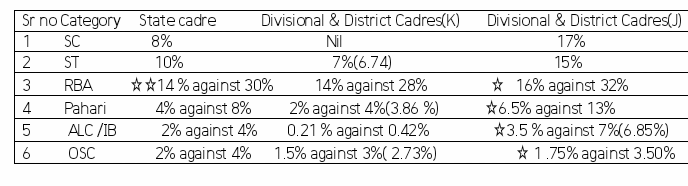
☆ since the total reservations exceed 40% after leaving aside 10% for EWSs proportional reduction to be effectuated to restrict it within 40%.
☆☆ Against RBA 1% reduced to restrict the reservations within 40%.
Admissions in the UT Universities.
In the two UT Universities the admissions are restricted to the candidates of Colleges affiliated with them Which makes them effectively as regional universities but reservation policies followed lack logic as neither UT level nor Divisional level demography is represented in the reservations provided for. In national universities the percentage of reservations represents the national demography. Jawaher Lal Nehru University provides reservations @ 15% for SCs, 7.5 % STs and 27% OBCs corresponding to their respective proportional population in the Country. This stands generalized subsequently under Central Educational Institutions ( Reservation in Admission) Act 2007 applicable to all central educational institutions throughout the country. Since the UT universities cater regional Colleges therefore the reservations ought to be worked out on the basis of regional demography but the position is not so. Either the admissions should be open for all domiciled in the UT without any impediments including the factor of eligibility from the affiliated Colleges subject to the reservations applicable across the UT or in alternate in the context of Divisional stratification the reservations to correspond with demographic features of the Division concerned. The table below shall illustrate the stand point:-
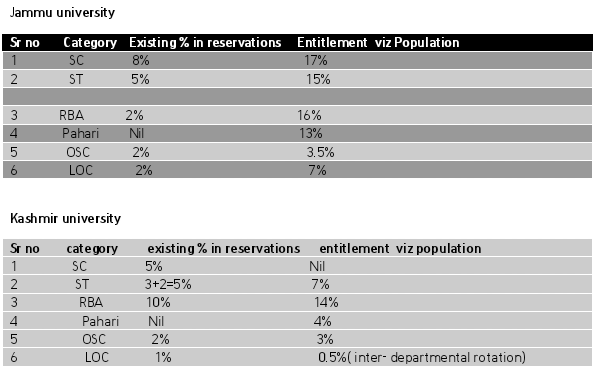
The quota for Leh & Kargil Distts, Sports persons, NCC, NSS and others should subsist & wherever the reservations are likely to exceed 40% limit after accounting for 10% for EWS from 50% cap as seems to be the position in Jammu university the tool of reduction applied proportionately to all eligible categories.
The Author is former Chairman JKPSC & can be reached on aaluzdeva_221256 @ymail.com.

 www.snskashmir.com