Shaharbeen News Service Kashmir is a news service which covers, gathers, writes, and distributes news to newspapers, periodicals, radio and television broadcasters, government agencies, and other users. We at SNS Kashmir believe in fair and independent journalism to inform our masses or subscribers and readers about the happenings around the world. The prime focus of the news gathering and reporting is focused on Jammu and Kashmir state.
Azad, Mir, Laway, Shamsher to complete term next month
SNS KASHMIR
SRINAGAR, JANUARY 08 :
With Jammu & Kashmir’s four sitting Rajya Sabha members set to complete their term next month, the Union Territory would remain without representation in the House in absence of the Legislative Assembly.
Details available with news agency—Kashmir News Observer (KNO) lay bare that all four Rajya Sabha MPs from J&K would complete their six-year term next.
While Fayaz Ahmad Mir (PDP) and Shamsher Singh Manhas (BJP) would complete their term on February 10, Ghulam Nabi Azad( Congress) and Nazir Ahmad Laway( expelled PDP leader) would hang up their boots on February 15
Azad, former Chief Minister of J&K, is the leader of the opposition in Rajya Sabha.
While Mir, Singh and Laway were elected as members of the House due to tactit understanding between PDP and BJP before they joined hands to form government in erstwhile state of J&K, Azad managed to win after getting support from National Conference and Independents.
After Centre abrogated Article 370 and reorganized J&K into two Union Territories in August 2019, their remaining term was protected by “The Jammu & Kashmir Reorganisation Act-2019”.
With this development, Jammu & Kashmir would remain without representation in Rajya Sabha until Assembly elections are held.
“The electoral college for these four Rajya Sabha seats comprises of MLAs of J&K UT Assembly. Since there are no MLAs presently in J&K, these seats would remain vacant. These seats can be filled only after Assembly elections,” an official told KNO.
According to amendments made in The Representation of Peoples Act-1951 in March last year, the electoral college for Rajya Sabha seats of J&K comprises of its MLAs.
It is worthwhile to mention that J&K UT Assembly will have 90 MLAs—(KNO)
“If anything happens in a home, it’s head is blamed”
SNS KASHMIR
SRINAGAR, JANUARY 8 :
Member Parliament and senior PDP leader Fayaz Ahmed Mir today accused National Conference of fielding their DDC candidates on the seats alloted to them in Kupwara by PAGD leadership.
” on 14 seats in Kupwara, like Hyama, Karnah, Ridi, Kralpora, Drugmulla, everywhere they fielded their candidates going against the PAGD decision. When PAGD took a decision about fighting the joint election, I and Bashir Ahmed Dar ex MLA and National Conference leader also decided to adhere to the decision for the bigger cause. But National Conference fielded candidates on all the 14 seats,” he told “Kashmir News Service’ (KNS).
“In every constituency there were proxy candidates. Gupkar alliance knows everything. They should have taken the action,” he said.
When asked does he blames PDP leadership also, he said, ” Whatever the decisions were taken by PAGD leadership were not adhered on the ground. All of us nominated proxy candidates. What was the fun of PAGD then. We were given one seat in Handwara and Karnah each and no seat in Kupwara, Karnah. In Karnah NC nominated their proxy candidate. we were given two seats in Lolab, but at both places NC nominated it’s own candidates”
Responding to a question, he said, ” My intention to tore my shirt in parliament was my protest against holding the whole population of Kashmir at gun point after abrogation of Article 370. I asked home minister to fire at me. Then we were removed from Parliament”
He added that at some places PAGD seat sharing agreement was adhered but at most of the places it was not adhered and PAGD leadership should have taken against those responsible for violations.
On being asked why all PAGD leadership is maintaining silence now after DDC polls, ” People here have always been deceived. But this time through mainstream parties. If you boast of unification for the cause, then you leaders, MLAs, MPs don’t adhere to the decision. Are not they deceiving people? Are not we again pushing people to quagmire?”
He clarified that they won’t even discuss statehood as it has been promised in Parliament.
” They have to give statehood at any cost. Article 370 was given by this country not Pakistan..this is not a crime to talk about Article 370.we will talk about our rights.”
On being asked whether he blamed the party president Mehbooba Mufti for the poor performance of PDP, he said, ” If anything happens in a home, it’s head is blamed. As far as Mehboba G is concerned, she is not to be blamed for it. Yes the vision of Mufti sb to pull out this state from Quagmire has stalled by our leaders. This is the reason we are showing downward performance after every election. Mehbooba G can speak better on it” (KNS).
The Border Security Force on Friday apprehended six Pakistani youths from the area along the India-Pakistan international border in Punjab, official sources said.
All those nabbed are aged between 20 and 21 years. They were apprehended from the border area in Amritsar around 5 PM, they said.
The six youths, the sources said, are currently being interrogated by a joint team of security and intelligence agencies to ascertain if they reached the border inadvertently or had some ulterior motive.
NEW DELHI jan 8: The procedures of informing the family of the date of the execution and facilitating the last meeting with the convicts were “perhaps… not fully adhered to” in the case of Afzal Guru and Yakub Memon, felt former President Pranab Mukherjee.
As the President, Mukherjee had also asked the then Home Minister Sushil Kumar Shinde to reconsider the decision of death penalty for Guru but Shinde reiterated the stand of capital punishment, as had his predecessor P Chidambaram, following which the former President had to concur with the home minister’s recommendation.
Mukherjee in his last book ‘The Presidential Years-2012-2017’, published earlier this week, writes on a range of issues including capital punishment. During his tenure as the President, Mukherjee rejected a total of 30 mercy petitions involving nearly 40 convicts, including those of Ajmal Kasab, Yakub Memon and Afzal Guru.
“Normally, the established process is that, once the execution of a convict is decided upon after all legal avenues have been exhausted by the convict and his family, then the convict’s relatives should be informed of the date and time of the execution. If family members—wife or children, for example—wish to visit the convict one last time, that too is facilitated. These formalities were not possible in Kasab’s case since nobody from Pakistan came forward with such requests,” he writes in the book.
He adds, “We also did not hear from Kasab’s mother. However, in the cases of Yakub Memon and Afzal Guru, perhaps these formalities were not fully adhered to.”
Among all the Presidents, Mukherjee turned down the highest number of mercy petitions during his tenure. But one of the highlights of Mukherjee’s presidency in this context was his setting aside the death sentence of four persons convicted of killing 34 upper caste people in 1992.
In his memoir, Mukherjee talks in detail about this rare gesture. These convicts were found guilty in the infamous Bara massacre case where armed men, allegedly Maoists, brutally killed nearly three dozen villagers of the upper-caste Bhumihar community in Bara village in Gaya, Bihar.
“The issue was a matter concerning Dalits and the massacre was some sort of retaliation on the atrocities committed on members of this community by other people.
I recall having gone through the case in great detail, reading the court proceedings and the judgements. The Bara case had left a deep emotional impact on me, but I took the view—as I did in other cases—that my sentiments must not cloud the fact that in decision-making, the actions and functions of the state machinery should be taken into consideration.”
Mukherjee adds that he granted mercy and commuted the death sentence of the four Bara convicts “because I found that the killers had acted in an exceptional frame of mind- even the court had made a similar observation. One of the convicts was very young, and courts usually take into consideration the age factor in deciding on capital punishment.”
The former President also weighed in on the question of the abolition of capital sentence, which was hotly debated during the execution of Guru and Memon.
“I am not very enamoured by the popular sentiment that the death penalty should be scrapped. Deterrence is absolutely needed in the rarest of rare cases,” he writes.
Mercy plea rejections
Among all the Presidents, Mukherjee turned down the most mercy petitions during his tenure. He rejected a total of 30 mercy petitions involving nearly 40 convicts including Azmal Kasab, Yakub Memon and Afzal Guru.
Lieutenant Governor Manoj Sinha will be presiding over January 26 function and take salute at Jammu and his advisor, Baseer Ahmad Khan, at Srinagar.
The main function, as per a handout available with GNS, will be presided over by Lieutenant Governor at M.A Stadium Jammu. While Baseer Ahmad Khan will oversee the function at Srinagar, Deputy Commissioners’ of respective districts will preside over the officials functions’ at respective district headquarters.
BDC Chairpersons’ will oversee the functions at respective Block headquarters, President Municipal Council Committees at respective Municipal headquarters and Tehsildar/Senior most civil officer at respective Tehsil headquarters wherever BDC Chairperson is not available. (GNS)
Jammu and Kashmir Public Service Commission (JKPSC) has on Friday announced recruitment for various posts under Combined Competitive (Preliminary) Exams for the ongoing year.
Through the recruitment process, the Commission intends to fill-up 257 vacancies for posts including; Junior Scale of J&K Administrative Service, J&K Police (G) Service and J&K Accounts (G) Service.
For the post of Junior Scale of J&K Administrative Service a total of 56 vacancies have been announced which include 28 under OM, 6 under RBA, 5 under SC, 6 under ST, 2 under ALC/IB, 5 under EWS, 2 under PSP, 2 under SLC, while as 141 vacancies for J&K Police (G) Services includes 70 under OM, 14 under RBA, 12 under SC, 14 under ST, 6 under ALC/IB, 14 under EWS, 6 under PSP and 5 under SLC.
Similarly 60 vacancies have been announced for J&K Accounts (G) Service which include 31 under OM, 6 under RBA, 5 under SC, 6 under ST, 2 under ALC/IB, 6 under EWS, 2 under PSP, 2 under SLC.
The vacancies, as per the notification, will be filled up in accordance with the provisions contained in the Jammu and Kashmir Combined Competitive Examination Rules 2018 (SRO-103).
Notification inviting applications for the Preliminary Examination is likely to be issued in the third week of January while as the examination (preliminary) is likely to be held in the last week of June or first week of July 2021, the notification reads further. (GNS)
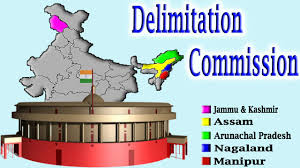
Delimitation in Jammu and Kashmir (Assembly and Parliamentary Constituencies): Agenda and Realities
A A Latief U Zaman Deva
With the de-operationalisation of Article 370 of the Constitution of India all the provisions of the Constitution without any exception or modification became applicable to the erstwhile State of Jammu and Kashmir, later downgraded into two union territories of J&K and Ladakh. Under section 14(3) read with section 60(1) of the J&K Reorganisation Act, 2019 (Act of 2019) 114 seats have been provided for the J&K Legislative Assembly out of which 24 are reserved for the territories which are currently with Pakistan [section 14(4a)]. It is worth noting that under section 14(4)(b) of the Act of 2019 such 24 seats are to be excluded for the purposes of carrying out delimitation of constituencies in the new union territory and therefore the delimitation restricted to 90 seats only.
Law and the precedents in J&K
By virtue of 84th Constitution amendment Act 2001 ,enacted during the Vajpayee regime, in Article 170 of the Constitution the delimitation of constituencies of all the State Assemblies has been frozen till 2026 when the relevant data of Census 2021 is supposed to be available but the votaries of ‘One Nation and One Law’ chose to make an exception in case of J&K on spurious grounds including the one related to the reservation of seats in the Assembly for STs which could have been settled without reopening the delimitation itself. With a view to bypass the prohibition laid down under Article 170, Article 239 has been applied to J&K under the Act of 2019 which originally has application to the UT of Pondicherry with implications for application of a law notwithstanding being contrary to the Constitution. On the strength of section 62(2) of the Act of 2019 the Delimitation Act 2002 applies to the union territory of J&K and for the purposes of delimitation reference to the population is to be construed as population determined by the 2011 census [section 62(1)(b)]. The population of the erstwhile state in accordance with the 2011 census was 1,25,41,302 and by excluding 2,74,289 as the population of the Ladakh, the population of the union territory of Jammu and Kashmir comes down to 1,22,67,013. Article 170(2), for the purposes of delimitation in states prescribes that “each State shall be divided into territorial constituencies in such manner that the ratio between the population of each constituency and the number of seats allotted to it shall, so far as practicable, be the same throughout the State.” This suggests that as a primary criterion the average population should be the same throughout the constituencies. Given the total number of seats in the legislative Assembly of the union territory (90) and the total population (1,22,67,013), the average population that each constituency must have is 1,36,300. Even though Article 170 does not talk of union territories, but as the highest law of the land, it provides the primary guiding principle governing the delimitation law i.e. population is to act as the principal factor for delimitation of constituencies.
The “other factors’’ that are to be employed for delimitation are contained in section 60(2) of the Act of 2019 namely “(a) all the constituencies shall be single-member constituencies; (b) all constituencies shall, as far as practicable, be geographically compact areas, and in delimiting them, regard shall be had to physical features, existing boundaries of administrative units, facilities of communication and conveniences to the public; and (c) constituencies in which seats are reserved for the Scheduled Castes and the Scheduled Tribes shall, as far as practicable, be located in areas where the proportion of their population to the total population is the largest.” Sub-clauses (b) and (c) are important. Sub-clause (b) mandates that the delimited constituencies based on population must be geographically compact areas, and while delimiting them, factors such as physical features, boundaries of administrative units, facilities of communication and public conveniences are to be taken into consideration. Sub-clause (c) is self-explanatory.
In the delimitation of Jammu and Kashmir legislative Assembly constituencies by the Delimitation Commission headed by Justice K K Gupta in 1995, the number of seats in the legislative assembly was increased from 76 to 87 and dispersal thereof made on the basis of population across the state except in districts of Leh and Kargil where the number of assembly segments was increased from one each to two each on the basis of distinct and unique geographical factors separating the two from rest of the state but despite being constituents of Kashmir Division the relaxed standards stood applied to the areas concerned only and not to the entire Kashmir Division. The concept was further implemented in districts Baramulla (now Bandipora) and Kupwara where new assembly constituencies namely Gurez and Karnah were carved out respectively on the strength of reasons aforementioned. Relevant to mention that ethnically and linguistically the people in the two districts of Leh and Kargil and assembly segments Gurez and Karnah are separate and together with the isolation imposed by geographical conditions resulting in their areas remaining out of bounds for six to eight months from rest of the erstwhile state.
National-level positions
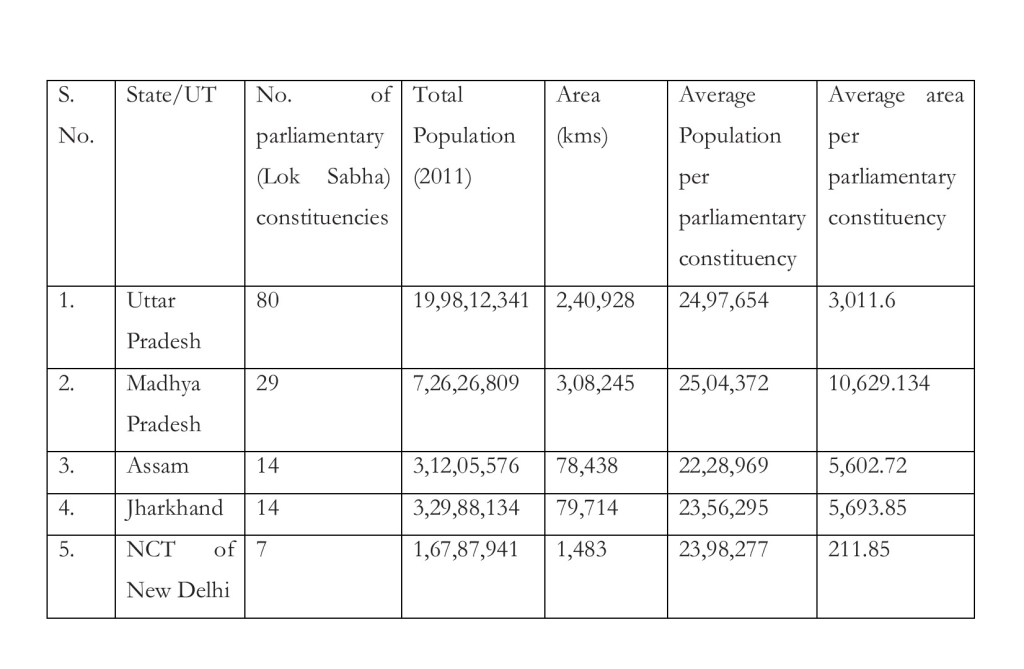
The population as a preponderant factor has been the hallmark in the delimitation of parliamentary constituencies which is illustrated down below by the number of parliamentary (Lok Sabha) constituencies allotted to Uttar Pradesh, Madhya Pradesh, Assam, Jharkhand and NCT of New Delhi:
In recent years the delimitation was undertaken in the states of Gujarat and Uttarakhand where Patwar Halquas to Revenue sub-divisions as administrative units were broadly adopted without splitting them for delineating the boundaries of Assembly segments on the basis of average population worked out by dividing the state population with the number of Assembly Segments and departures made as exceptions to the general criteria regardless of the size of population wherever the geographical contiguity and other factors in mapping of a Constituency made it apart and distinct from the surrounding areas owing to mountains, river systems and communications impediments.
Malafide narratives
Known Dogra centric contrarians in Jammu City have already vitiated the environment for dispassionate debates by questioning the veracity of Census 2011 by demanding the factors like number of voters and expanse of area to be adopted as the main criteria for delimitation of Constituencies. These three planks are examined as under:
Population: As in the past right from 1891, the Census of India 2011 was also undertaken in the States by the Office of the Registrar General India through the Regional Directorates under the supervision and control of the former. The animosity against Muslim population has been the traditional disposition of thriving bigotry but this time around even central government’s institutions are not being spared little realizing about the all-pervading non- existence of Muslims in the hierarchy more so at decision-making rungs in the whole country. Out of 125 lakh persons listed as State population 6.05 lakh persons have returned such mother tongues as are neither prevalent nor spoken in J&K nor specified as regional languages in the Constitution of erstwhile State. Evidently these persons are employees of GOI or migrant workers or both which is corroborated by the mismatch in their gender break up and incidentally overwhelmingly co-religionists of hate mongers. This Segment of population doesn’t fall in the category of permanent residents of the State and don’t even qualify for domicile status under the new rules in force. The percentage of population by religion for Hindus shall reduce to 24.98 from 28.44 once these non-natives are set apart. Out of these 6.05 lakh persons 32223, 1,65,083 and 4,03,024 are in Ladakh, Kashmir and Jammu Divisions respectively with mother tongues like Assamese, Bengali, Bodo, Gujarati, Kannada, Konkani, Maithili ,Malayalam, Manipuri Marathi, Nepali, Odia, Santali, Sindi, Tamil ,Telugu, Hindi, Urdu and many more other scheduled and non- scheduled languages. The question raised about this segment of population is best answered in the electoral rolls of the pair districts of Ladakh reflecting as they just 50 (35+15) Hindu voters and not 19,334 @ 60:40 criteria applicable to Hindu population 32,223 figuring in the census of 2011. These persons are obviously non-natives working in the union territory and the same applies pari passu to J&K. However the official Census shall be the basics in various projections and conclusions of this write up but then Who should ring alarm bells about the genuineness of the total population of J&K?
Voters and their numbers: Generally 35 to 40 % of the total population fall in the age group of 0 to 18 and hence the number of voters not to exceed 60% of the population except in specific categories of people for reasons of life expectancy being beyond 70 and highly lowest rate of infant mortality but the persons above the age of 08 during the Census enumeration becoming eligible for registration as voters by the next phase of the enumeration of following decadal Census doesn’t make substantial difference in the projections due to the rate of deaths, migrations & uneven population growth rates in various communities. While the percentage of voters is 71.29 against the population of 5236348 in Jammu Division; it is 58.33 in Kashmir Division for population of 7023665 and by excluding the persons not speaking such mother tongues as are in J&K the percentage in former grows to 77.23 and in latter 59.73. Individual cases of district of Reasi, Kathua and Jammu depict voter percentage to Census population at 83.75, 79.80 and 71.55 respectively. By excluding 91733 migrants from the population of Jammu District, being registered voters in respective Assembly Constituencies in Kashmir Division, the percentage of voters jumps to 76.11 from 71.55. The uprising like situation accompanied with total apathy of eligible persons for being registered as voters in Greater Kashmir witnessed quite negligible accretion in voter lists from 1986-87 to 2002-03 when quite on heels of Assembly elections 2003 under the subterfuge of voter identity cards the mobile population in the Valley was left with no option except to get enrolled in the Voter lists resulting into the substantial upsurge in the no of voters which continues thereafter but large sections of society still not in mainstream politics has led to shortfalls in the number of voters viz .the population on the analogy of standards at national level about percentage of voters over the population (above 60%). Let the protagonists of ‘foulness’ find the subtext detailed above against the vicious propaganda unleashed by frontal organizations of the Hindutva & answer about the mismatch between the population and no of voters in Dogra Loop of Jammu Division.
Area: J&K is undoubtedly an excellent example of unity in diversity as otherwise its 04 constituent units have nothing in common excepting administrative exigency with origin to the formation of the State way back in 1846. Geographically, ethnically and linguistically being apart from one another excepting commonalities between the Kashmir Valley and Chenab Valley the 04 regions are Jehlum Valley (Kashmir Division), Chenab Valley (outer Hills), Peer Panchal (Jhelum basin) and the sub-mountainous and semi- mountainous tract of Kathua, Samba, Jammu, Udhampur and Reasi Sub-Division. Nowhere in the world the quantum of area in itself is the bedrock for apportionment of seats in the legislative bodies and even the position at national level as expatiated elsewhere in the write up does point towards the population as the sole determining factor essentially as it is people who are to be represented in the Assembly and not lifeless immoveable land mass. The law laid down for J&K envisages the population as the determinant pivotal factor for fixing the number of Constituencies for the legislative Assembly and while doing so an area inaccessible, for larger parts of the year due to the geographical factors or isolated owing to canals, effusive and fiercely flowing rivers or highways with vehicular traffic of high density or linguistic majorities as an exception to the ethnic and linguistic background of surrounding areas could be delineated by properly fixing the boundaries for constituting as a separate Constituency whether the criteria for average population arrived at is met with fully or not. The Division or region as a unit is alien to the law of delimitation but by assuming it to be a relevant indices the benefits as outcome of the exercise should percolate down to the area itself. Chenab Valley with population of 924345 spread over the highly mountainous and relatively rugged terrains has on an average 1948.5 Sq kms per Constituency in contrast with Jammu District with 1438225 population (less by migrants) on area to the extent of 3097 Sq kms representing 1.30 lakh population on an average for an average area of 281 Sq kms and it is in this behalf maintained that the benefit of topography and vast inaccessible areas if at all made admissible contrary to the germane of law and rules should go to the area concerned. From another angle of total geographical area and population of Jammu loop from Patnitop to Lakhanpur as a distinct geographical region the average population and area per Constituency in all the 04 districts is 1.39 Lakhs and 452 Sq kms and in Kashmir Division it is 1.52 lakh population and 347 Sq kms respectively. The difference of 5.98 Lakh population favouring Kashmir Valley is off-set by the area factor in Jammu Loop even though contrary to the law but somehow Valleyites having acquiesced with the patent distortion no further comments offered. On the basis of law the benefit for areas attracting the application of ‘’ other factors’ while mapping the Constituencies it is Marwah and Wardwan, Padder and Gool in Chenab Valley qualifying for separate Constituencies as already such dispensation extended to Gurez and Karnah in the districts of Bandipora and Kupwara together with Leh and Kargil districts by Delimitation Commission in 1995 but as the accord of such treatment has to be intra-Districts the same may lead to indefensible outcries in the concerned areas by communities losing even the existing advantages.
Challenges and remedies.
Usually the constitutional and statutory bodies at national level and in the States are embodiment of demography but for quite some time now the underlying principle is amiss in favour of the majoritarian mind-set. The Asian/African candidates elected to the legislative bodies in USA and Europe brings joyous momentum to us without appreciating the receptivity of the Political parties in the foreign countries to broad base their political systems by having regard for demography as admittedly it is by dint of local populace the immigrants and their succeeding generations saddle in cozy chambers of respective legislatures. Latest instance is election of Kamla Harris, born in USA of immigrant parents with Jamaican father and Indian mother, as Vice president even as the black population in the Country is around 13.4% only. Incidentally Rahul Ghandi & Priyanka Ghandi born in India of Indian father & Italian mother are not lucky as Kamla is perhaps owing to the civilizational gaps & continue to get dubbed as foreigners by those celebrating electoral success of even persons of Indian origin in foreign countries. India Muslims constitute 14.5% of the total population of the country but their representation in the Lok Sabah has rarely exceeded 4% barring once and resultantly the elected members from the community remain pegged around 15 to 25 as against the due share of about 80. The reason for dismal representation is due to dispersal of Muslim population across the country without a definite territory inhabited by them overwhelmingly. With the same handicaps in foreign countries for the outsiders it is the accommodating political philosophy of the local governments which enables Asians to be leaders in countries not their father or mother lands or sacred insofar as their faiths are concerned. In India to distribute party tickets in conformity with the demographic features would decimate the concerned Party unless its application assumes multi-partisan support. In the sub- continent people believe in hero worship and therefore the credentials of the candidates matter little. The leaders leading the parties are crowd pullers and general electors vote for the candidates as minions of party leadership but denying the mandate to candidates from the minority is portrayed as the biggest achievement easily absorbed by the gullible people. This brings out the difference about the convictions for adherence to respect the demography between white men and the Asian governments.
While constituting the Delimitation Commission (DC) by central Governments, directly ruling the UT of J&K for the last over two years, in the aftermath of 5th August development the nature of the composition should have been re-assuring as the mandate for the new DC concerns Muslim majority UT. In the distraught overtaken people even the transfer of the Chief Electoral Officer following the constitution of the DC has given rise to the conjectures as the commoners are least aware of the ethos of the IAS officers who are supposedly to be guided by the Constitution and rule books unless someone may be a rogue or a fanatic unmindful of his/her position bedecked in neutrality and impartiality. In the past almost all Commissions instituted in the erstwhile state were headed by non- Muslims as strong confidence building measures even on occasions the exercises aimed at addressing the problems of the minority community albeit imaginary as invariably established in reports submitted which have gone unrebutted till date. Under these circumstances the DC should be and also seen to be neutral and impartial especially when people have become hopeless and are in dire need of positive vibes to embrace the consequences of lack of such a position can well be grasped.
The dichotomy in the data about migrant population remains unresolved even after Census 2011 which reflects 116750 Kashmiri population outside the State and 91733 and 7203 in the Districts of Jammu and Udhampur the inclusion of limited non- migrant Kashmiri population therein can’t be ruled out. Contrary to the population the number of migrant voters is 93373 only and applying the matrix of 60:40 but higher than the national average due to factors of life expectancy and low infant mortality the migrant population meriting inclusion in the demography of Kashmir Division comes to135190. Since the migrant population is to be included with the population of Kashmir Division for being registered as voters therein the population of said Division shoots up to 7023665 from 6888475 excepting the migrants settled outside the State and not registered as voters in the local Electoral Rolls and the population of Jammu Division gets reduced to 5236348 from 5371538 by excluding the Kashmiri population of Jammu and Udhampur Districts. At the average population of 136300 per Assembly Constituency the Kashmir Division ought to have 51 seats @ 137718 and Jammu Division 39 @ 134265 .
After the delimitation of the Assembly Constituencies in 1995, the State Governments during the year 2006-07 created 08 new Districts namely Kulgam, Shupyan, Ganderbal, Bandipora, Ramban and Kishtwar, Reasi and Samba out of the Districts of Anantnag, Pulwama, Srinagar, Baramulla, Doda, Udhampur and Jammu respectively. There are Assembly Segments falling in more than one district like Homshalibug and Devsar in Anantnag and Kulgam, Sumbul Sonawari in Bandipora- Ganderbal, Chadoora in Budgam and Srinagar, Gool-Arnas in Reasi and Ramban, Ramban in Ramban and Doda, Inderwal in Doda and Kishtwar and Hiranagar in Kathua and Samba. Since the new Districts came into being after marathon meetings and deliberations ever since the report submitted by Wazer Commission in 1983 for rationalisation of the administrative units, it would be advisable to maintain the existing boundaries of the districts by retaining the main Constituencies in the respective Districts and portions falling in nearby Districts to be excluded from the existing Constituencies for adjustments in the Districts to which they currently belong to. However, while proceeding in the manner suggested the Constituencies in new Districts may suffer shortfall viz the average population fixed across the board in the UT which can be overcome notionally by the surpluses in remaining constituencies situated in the natural region / sub-region / areas with historicity. By way of an illustration the population of Kulgam District is 430573 and on the basis of average population @ 136300 fixed for Constituencies it falls short by 111439 in toto for 04 Segments of Noorabad, Kulgam, Homeshalibugh and Devsar falling in the said District which is addressed by the surpluses available in Maraz comprising of Districts Anantnag, Kulgam, Shupyan and Pulwama even after increasing one Assembly Segment in District Anantnag raising the no of Constituencies from 06 to 07 by inclusion of areas from Homshalibug and Devsar otherwise falling in the said District. The population of Maraz is 2380550 and the average population per Constituency works to 140032 for 17 Segments above than UT average of 136300 (16 existing and 01 proposed for Anantnag). In regions like Chenab Valley and Peer Panchal, apart from the population factum the “other factors’’ are singularly applicable provided there are no hiccups as in such a dispensation the apple- cart merchandised as a dream shall come to a grinding halt. (To be continued….)
The author is IAS (Retd ) and former Chairman of the J&K Public Services Commission who can be reached on aaluzdeva_221256@ymail.com .
Disclaimer:The views and opinions expressed in this article are those of the authors and do not necessarily reflect the editorial policy or position of SNS KASHMIR
The Jammu and Kashmir government on Friday sought details of items which require Geographical Indications in order to protect them from counter branding.
Geographical Indication or GI is a sign used on products that have a specific geographical origin and possess qualities or a reputation that are due to that origin. These are typically used for Agricultural Products, Food stuffs, Handicrafts and Industrial Products.
The Ministry of Commerce and Industry, Government of India has advised that all the departments of the J&K may be directed to furnish details of items which require geographical indications registration under the Geographical Indications of Goods (Registration and Protection) Act of 1999, reads a circular issued by Manoj Kumar Dwevidi, Commissioner Secretary to the Government Industries and Commerce Department. As a part of the efforts to protect the local goods known for their qualities and reputation, nine items including Saffron from Jammu and Kashmir have Geographical Indications registration.
“There are many goods which require protection so as to avoid counter branding of the same,” the circular, a copy of which lies with reads, adding, “Therefore, it is enjoined upon all the Administrative Secretaries to furnish details of items which require Geographical Indications registration with Industries and Commerce Department, so that same is shared with the Ministry of commerce and Industry, Government of India.”
Jammu Kashmir High Court Friday directed Bar Counsel of India to consider the representation of Kashmiri Lawyers to get an examination centre established in Kashmir Valley for the ‘All India Bar Examination.
Pertinently, ‘All India Bar Examination’ is being conducted with no examination centre in Kashmir capital Srinagar. The aspirants are decrying injustice, appealing the Bar Council to set up an examination centre somewhere in Srinagar.
Sources told KNT that in this regard Advocate Parvaiz Lone filed a writ petition before J&K High Court seeking directions for Chairman Bar Counsel of India to establish Examination Centre for Kashmir Division in Srinagar. The petitioner in his petition submitted that it is very hectic and undesirable for Kashmiri aspirants to visit Jammu.
Justice Sanjeev Kumar after hearing the arguments of Advocate Parvaiz Lone directed Chairman Bar Counsel of India to consider the representation and decide the same before the commencement of this examination. (KNT)
Chakkan-Da-Bagh crossing point along the Line of Control in Poonch district was opened for 20 minutes on Friday to allow two boys, one of them from this mountainous district and other belonging to Pak, to be repatriated. Both the boys had inadvertently crossed the LoC within the last fortnight.
“The gate at Chakkan-Da-Bagh crossing point opened at 12:40-13:00 hours for handing and taking over of the boys of both sides who had illegally crossed over to (Pak) from sector Bandichechian and entered into this side from sector Gulpur,” an
The boys were handed and taken over by authorities on either side in presence of witnesses after completing legal formalities, the official said. One among them, Mohammad Shabir (17) son of Mohammad Bashir Gujjar of Mandhar Mohallah Kayian had gone missing from his house on 24 December last year and had crossed over to Pak via Kirni Bandichechian sector along the LoC.
In this regard, a missing report was lodged at police station Poonch on 25 December 2020, the official said. Similarly, the boy from Pak, Ali Haider (14) son of Mohammad Sharief of Bandi -Abbasspur (Pak), was apprehended by SOG Poonch on 31 December last year from Gulpur sector.
DIG Rajouri Poonch Range Vivek Gupta that the meeting of the officials from either side of the LoC point was fixed formally and subsequently handing over and taking over of the boys took place.





You must be logged in to post a comment.