Shaharbeen News Service Kashmir is a news service which covers, gathers, writes, and distributes news to newspapers, periodicals, radio and television broadcasters, government agencies, and other users. We at SNS Kashmir believe in fair and independent journalism to inform our masses or subscribers and readers about the happenings around the world. The prime focus of the news gathering and reporting is focused on Jammu and Kashmir state.
In an order, the General Administration Department (GAD) said the procedure for granting permission in favour of government employees for private visits to foreign countries has been prescribed clearly by the administration.
SNS KASHMIR
JAMMU, FEBRUARY 15 :
Taking a serious note of its employees visiting foreign countries in private capacity without prior permission, the Jammu and Kashmir administration has directed them to follow the rules strictly and threatened to take action against violators.
In an order, the General Administration Department (GAD) said the procedure for granting permission in favour of government employees for private visits to foreign countries has been prescribed clearly by the administration.
It has been provided that the station permission for proceeding outside the country on private affairs shall be granted by the administrative department in the same manner as leave outside the country, the order issued by Commissioner Secretary, GAD, Manoj Kumar Dwivedi read.
Further, the order said the finance department in its circular on February 21, 2019 inter alia clarified that prior permission of the competent authority for leaving the station would be mandatory when a government employee intends to visit a foreign country in private capacity.
It has, however, been observed that the officers/officials of various departments are proceeding on foreign visits without obtaining prior permission of the competent authority, in violation of rules/norms, as a consequence of which such cases are recommended for post facto sanction thereby defeating the purpose of an elaborate set of instructions/guidelines notified on the subject. The matter has been viewed seriously by the authorities, the order said.
The order impressed upon all the officers and officials working in various government departments, public sector undertaking, boards and commissions to strictly adhere to the instructions issued on the subject and not to undertake any foreign visit on private affairs without prior approval of the government.
Administrative secretaries, heads of departments shall take note of these instructions and take appropriate action against the defaulters and shall not process any case for post facto sanction, it said.(PTI)
“People of J&K were deprived of basic rights. Few vested interests hampered the development reaching the doorsteps of the people for decades”, says the LG
J&K has a development deficit of 73 years; there will be challenges to fill the gaps, administration is fully prepared to deal with it: LG
Development of J&K, aspirations & dreams of people were suppressed by few people under thoughtful strategy. Steps being taken to correct the errors of history: Lt Governor, Lt Governor releases book “Notes on Kashmir”
SNS KASHMIR
MUMBAI, FEBRUARY 14 :
“Withnew economic and industrial reforms, J&K has become a promising destination for investors”.
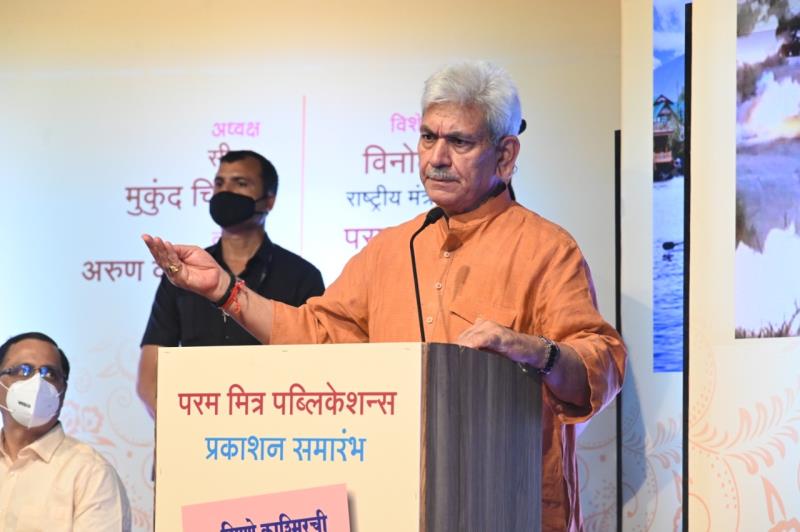
Lieutenant Governor, Manoj Sinha made these remarks during the release of the book – Tipane Kashmirchi(Notes on Kashmir), untold stories authored by Sh. Arun Karmarkar.
While speaking on the occasion, the Lt Governor observed that changes that have taken place in the last 18 months have given a determined push to the socio-economic development, besides empowering the common people in Jammu and Kashmir Union Territory for the first time.
“J&K has a development deficit of 73 years and there will be challenges to fill the gaps, but the administration is fully prepared to deal with it”, said the Lt Governor.
Speaking on Economic reforms, the Lt Governor observed that a new Industrial Development Scheme of Rs 28,400 crore has been unveiled for attracting investment in the UT, besides creating opportunities for the youth. With such a scheme and a ready land bank, the investors would find J&K as a promising destination for their investments. The UT Government is committed to take industries up to the block level for inclusive growth.
I have visited different parts of the Union Territory continuously in the last 6 months. 70 percent of the population is below 35 years and there is no shortage of manpower and resources. We are taking comprehensive measures through initiatives like Mission Youth to harness demographic dividend and ensuring youth’s engagement in a constructive way, contributing to the overall development of J&K, the Lt Governor added.
Underscoring the reformative initiatives taken by the Government for the growth and prosperity of J&K, the Lt Governor said that the second installment of Rs 250 crore to Jammu and Kashmir Bank as Interest Subvention was disbursed on the 11th February. The first installment of Rs 250 crore was released last year as part of our Rs 1350 crore economic package and 3 lakh 41 thousand small and big business units were given relief from the trauma of the corona epidemic.
On power generation, the Lt Governor said that despite the immense potential of Hydro Power, only 3500 MW of power was generated in J&K in the last 73 years, causing small businesses and citizens to face power problems. We have approved several projects worth Rs 54,000 crore within 3-4 months and we aspire to generate 3500 Megawatt of power in the next four years to make Jammu Kashmir a power surplus.
Compared to other states, the budget of Jammu and Kashmir has been four to five times more in per capita, yet the development that should have been done, the kind of industrialization that should have taken place has not happened, he added.
The Lt Governor, while speaking on the opportunities created for the young entrepreneurs observed that an amount to the tune of Rs 264 crore has been disbursed as financial assistance to 16,800 youth (against the assumed targeted of 8500) identified from all the 4290 Panchayats in J&K to become entrepreneurs under the Back to Village. All the Panchayats have been provided with sports kits worth Rs 20,000 each during the Back to Village-3 programme as per the local requirements, he added.
The Lt Governor remarked that – “The people of Jammu and Kashmir were deprived of basic rights. Few vested interests hampered the development reaching the doorsteps of the people for decades”.
He said that there is no escape from accepting the truth that deliberately, under a thoughtful strategy, the development of J&K, the aspirations and dreams of the people were suppressed by a few people and a particular section. We have taken another big step to correct the errors of history.
Speaking on the abrogation of Article 370 and its impact, the Lt Governor observed that on 5th August 2019, the Hon’ble Prime Minister Narendra Modi Ji, by abrogating Article 370 of the Constitution, gave Jammu and Kashmir the status of Union Territory and fully integrated it into the mainstream of the nation. And for a long time, the conspiracy being run by those certain classes of people against the people of Jammu and Kashmir was destroyed in an instant.
Quoting the Prime Minister, the Lt Governor said – “Articles 370 and 35A gave Jammu and Kashmir nothing but massive separatism, terrorism, nepotism, and widespread corruption”.
With a population of 1 crore 30 lakh, J&K was not only connected with the mainstream of the country but the new dawn of development and trust has been witnessed across the Union Territory, he added.
The Lt Governor observed that recently, peaceful, violence-free and fair elections were held for the District Development Council and the three-tier Panchayat system was established to strengthen the grass root democracy, paving the way for progressive future of the UT.
The polling stations across the UT witnessed long queues of enthusiastic voters and people came out to vote in large numbers, despite harsh weather conditions, with the voter turnout percentage even in the traditionally low percentage areas registering manifold increase, which itself manifests that faith of the people of J&K in the democratic process has deepened, he added.
Today, Jammu and Kashmir is number one in the entire country in terms of progress under the Pradhan Mantri Gram Sadak Yojana.Every village will be connected with road, power and water supply in J&K in the next two years. A robust mechanism has been put in place for effective and prompt redressal of people’s grievances.
Sectors like handicrafts, food processing, horticulture, tourism, education, skill development, sports, culture, and the film industry are growing at a rapid pace. The UT administration is fully committed to make Union Territory the most favorite destination of filmmakers, the Lt Governor added.
Bringing reforms in the horticulture sector, the UT Government has initiated the process for high density plantations, cold storage cluster, market linkage, and GI tagging of local products, besides, the target of covering 5500 Hectares of land in the next five years with a major focus on Apple, Walnut, Cherry, Pear, and other significant horticulture produce. High Density plantation of Apple, Walnut, Cherry, Flowers, etc would increase the income of farmers by 3 to 4 times, observed the Lt Governor.
These are just a few glimpses of the development revolution that is taking place in Jammu and Kashmir, the Lt Governor said.
Throwing light on the history of Jammu and Kashmir, the Lt Governor observed that a lot of upheavals can be seen if one goes through the facts.
A National Seminar and Exhibition on “Memories of 22 October 1947” in collaboration with the National Museum Institute of History of Art, Conservation and Museology was organized in Srinagar so that the younger generation of the UT can be told about the brutal atrocities of Pakistan, and how the people there confronted them. Documentary evidence of treacherous attack by Pakistan, Stories of resistance and bravery of the Indian Army were told to the people, during the seminar. A lot of time has passed since the 1947 invasion, but the wounds have still not healed, and it is our responsibility that the people of Jammu and Kashmir know the truth behind those incidents, the Lt Governor added.
Terrorism is the real enemy of humanity. The process of uprooting the fear of terrorism is going on at a rapid pace, he maintained.
The Lt Governor conveyed his best wishes to the author for his book and appreciated him for bringing out deeply researched facts about Jammu & Kashmir.
District Devlopment Commissioner Srinagar and incharge Divisional Commissioner Kashmir, Dr Shahid Iqbal Choudhary said that adminstration will address the concerns of Parents and Private School administration regarding School Fee & transportation before re-opening of schools in valley.
Taking exclusively with news agency-Kashmir News Service (KNS) regarding Reopening of schools in valley scheduled on March 1, Dr Choudharysaid, “
“The opening of schools amid Covid 19 with the huge enrollment is a big call and Standard operating procedures has been already notified to take precautions. Almost one thousand schools in Srinagar District with overall enrollment of one lac thirty thousand students will resume classes,” he said.
“We took the initiative to train Teachers of all educational institutions. They were trained regarding adoption of covid protocol,” he added.
Dr Choudhary further said that schools are being augmented with every requirement related to Covid Protection.
Department of Socialocial and Preventive Medicine as our Knowledge partner is providing technical support to education Department. “All the Heads of institutions have been trained as well in standard operating procedures,” he said.
“Steps will be taken on school level as well so to ensure confidence in students and parents which is very important to get more response of children in schools. Teachers of schools and other management has been trained and health department has been associated to provide required support to ensure safe and hasslefree opening of schools”, he added.
Regarding a question on call of Private Schools Association they will not offer Transport facility to students, Dr Choudhary said, ” there are lot of issues of parents and private schools and a recent interaction witnessed good advancement. As far as Transport issue is concerned. we will have them on table soon before reopening of schools to discuss these issues so that they can be resolved soon.”
Regarding the role of parents in reopening of schools, Dr Choudhary said that Parents will play an important role in Re-opening of schools related to confidence to themselves and their Children, ” There is need of active participation of parents in Re-opening of schools “.(KNS)
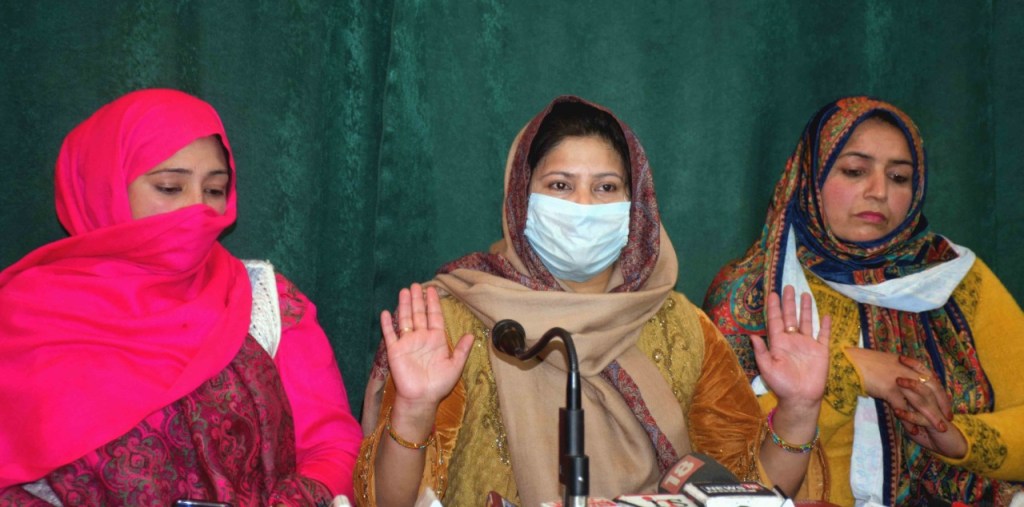
The Pakistani wives of many former militants who returned home under the state government’s rehabilitation policy held a Press Conference at Press Club, Srinagar on Monday blaming that the government has done nothing to help their families.
They added that dozens of women who came to the Valley along with their husbands who had gone across the border to obtain weapons training but returned home in response to the rehabilitation policy for former militants announced by the state government demanded the travel documents so that they can meet their parents and relatives from the other side of the border
“We have no identity, no ration cards, no schools agree to admit our children, our husbands have no source of livelihood,” said a Pakistani woman namely Toiba heading the delegation, who belongs to Bagh area of Pakistan-administered Kashmir had come with her husband and two children.
She also blamed that the state government is not issuing them travel documents to return to Pakistan.
It is pertinent to mention that the Pakistani wives have been continuously protesting from the last couple of years demanding the implementation of Rehabilitation policy and the travel documents. (CNS)
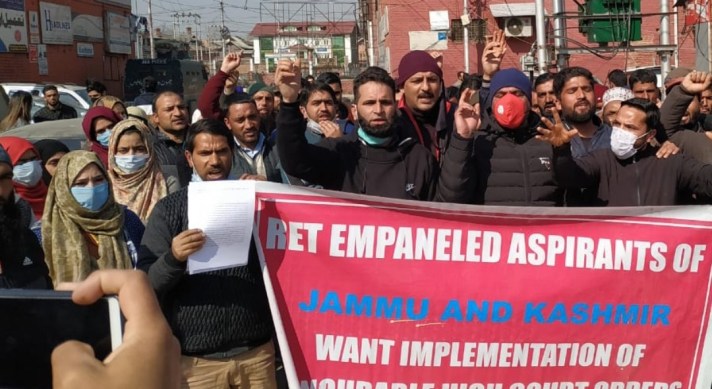
Scores of aggrieved Empanelled ReT aspirants under the leadership of Mr Mayasar Ahmad wani on Monday staged a protest demonstration at Press Enclave Srinagar over non serious attitude of administration towards their issue and on the occasion they demanded immediate issuance of their appointment orders.
The protesting aspirants while raising slogans in support of their demands cursed authorities for not issuing their appointment orders since 2015 which compelled them to hit streets repeatedly.
“Ironically, after the clear cut direction of the Judiciary from time and again the department is playing hide and seek with our future” said Altaf Hussain Itoo one of the aspirants.
He added that they are anxiously waiting and are facing starvation as many of them have turned overage, while others have their kith and kins to feed, He also blamed that the administration seems least bothered about their plight.
Mrs Asmat Hassan another protester expressed anguish over the claims and transparency of administration. She blamed that administration has already issued appointment orders in favour of some Blue-eyed and political influential candidates.
She added halting their orders unnecessarily have put question mark on the credibility of administration. They also warned to intensify their agitation if their demands are not met at an earliest.
Protesting aspirants sought the personal intervention of Secretary Education and Lt. Governor Sri Manoj Sinha for fulfilment of their demands without any delay.
They warned that if the stalemate continues for more time then they will not only hit the streets again but will intensify their struggle and the responsibility of which shall lie on the Government. (CNS)
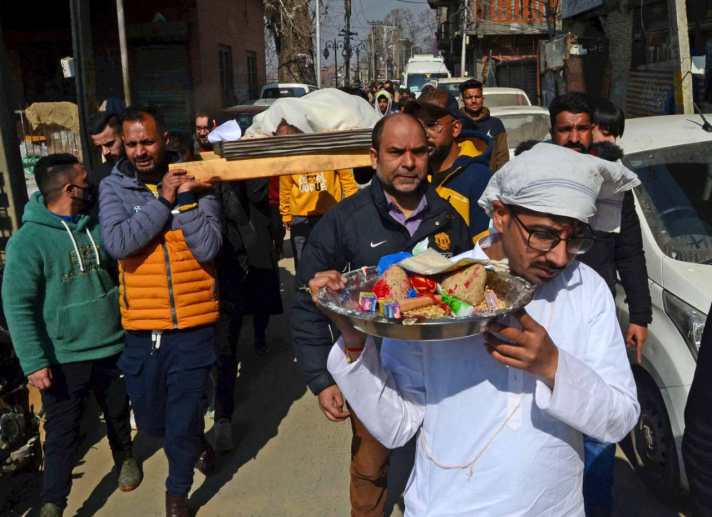
Muslims helped a Hindu family in cremation process of a man who died in Maisuma area of Srinagar city today.
Locals told KNT that one Rakesh Kumar who was not keeping well from past several months breathed his last. Muslim neighbours arranged everything required for the cremation process.
Locals said they arranged a priest and shouldered the dead body. Kumar was cremated at Batamloo area of Srinagar city.
The deceased was living with couple of family members. “He once had a flourishing ready-made garment business but losses in business affected his health and status,” said an elderly Muslim man.
He said Kumar had two sons but both abandoned him after he received set back in his business. (KNT)
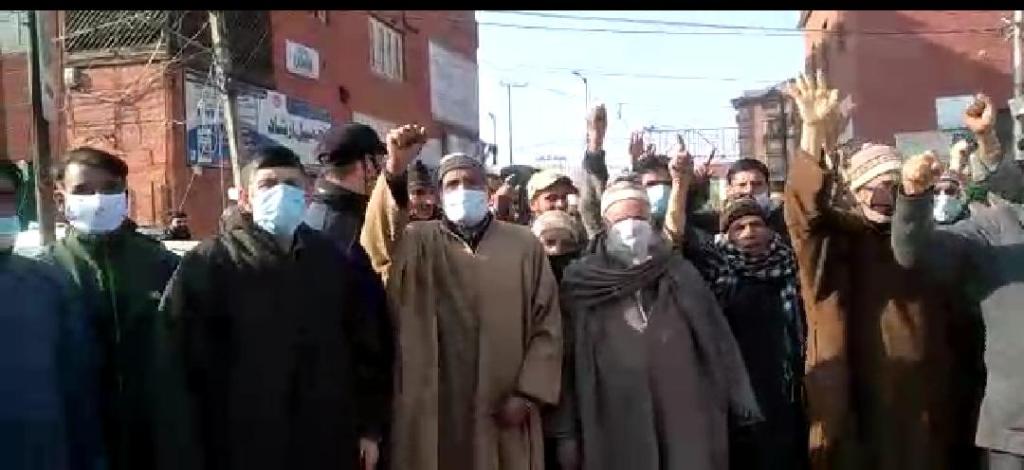
Locals from South Kashmir Monday accused Para-military troopers of forcibly trying to occupy land that they use for grazing animals.
Locals from Bran village of Shangus Tehsil of Southern Anantnag district assembled here in Press Enclave Srinagar and staged a protest against what they said ‘land grabbing’.
The protesters said that without any consultation and taking locals into confidence, CRPF has initiated a process to occupy land comprising of 100 kanals.
“It will prove disastrous for us. We graze our cattle in these fields from centuries and today they are forcibly taking this land from us,” one of the protesters told news agency Kashmir News Trust.
The protesters said that from past few days, CRPF troopers are visiting the said land and are demarcating it. “We raised the issue before Deputy Commissioner Ananatnag but of no avail. Today we met Divisional Commissioner Kashmir who assured us of action that will be in the interest of people,” they said.
They said this land has walnut and other trees. “It is a grazing land and if it will be occupied by Para-military troopers, our cattle will die,” they said and sought intervention of Lieutenant Governor Manoj Sinha. (KNT)
When the two core constituents of the Constituency of the despotic reign found themselves incapable of outpacing the ‘’Ghar Mulkies” in the recruitments against the posts in the State of J&K, they launched agitation for protections in services in favour of ‘’Mulkies” which later on resulted in issuance of a Notification in 1927 defining thereunder the ‘’State Subjects ‘’. The indigenization didn’t provide reprieve to the locals from corruption and red- tap but instead the whole bureaucracy along with the lower rung officials was highly coercive, arrogant & steeped in unprecedented corruption and inefficiency. Once the other stakeholders started claiming share in the jobs the protectionists became overnight the champions of non- discriminatory selection processes which remained in general elusive due to exercise of appointment powers by the political executives from time to time with seldom bouts of selections through independent institutions . It is only from 1968 onwards we find the State attempting to have a recruitment system devoid of interference from the Govtt which by now is perfectly transparent and merit based. Unfortunately owing to the past hangovers, while the general public is vying for merit based recruitments, some characters expect share on ethnic & linguistic basis which is impossible to fructify unless the system as a whole collectively degenerates, a rarest of rare possibility in contemporary times Where the persons charged with the assignments are generally fiercely opposed to manipulations. The demands for uncodified selections representing ethnic and chauvinistic foot prints runs counter to the concept of’’ Nation & Nationality’’ being espoused in political discourses by the same coterie and therefore its adherents should bury once & for all the pernicious debate affecting adversely the inter communal & linguistic harmony.
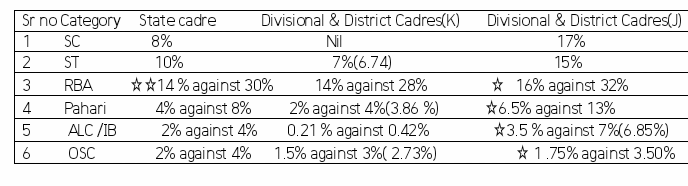
Under the J&K Reservation Act 2004 & J&K Reservation Rules 2008 as amended up to date the percentage of reservations for Scheduled castes(SC) is 8%, Scheduled Tribes (ST)10%, Residents of Backward Areas(RBA) 10%, Residents of line of Actual Control and International Boarders(LOC/IB) 4% ,Other Social Castes(OSC) 4% & Pahari Speaking Persons (PSP) 4%. Out of the entire SC population 85% is inhabiting in the Distts of Udhampur, Jammu, Samba and Kathua & Reasi sub-Division with remaining spread over the rest of Jammu Division,68% STs, 72% PSPs & 93 % LOC residents are domiciled in Jammu Division.It is only in the case of RBAs & OSCs who are near evenly dispersed across the UT which is manifested by their being respectively 53% & 50 % in Kashmir Division. The population covered under categories listed above is 62.86% of total UT population and out of the said Segment 63.20 % fall in Jammu Division.
Unprincipled apportionment.
The reservations at national level for SCs, STs & OBCs is proportionate to their respective population and accordingly in recruitment to central services & admissions in the central universities/ national institutions the reservation for these three categories is respectively 15%,07.5% & 27% in proportion to their populations. In J&K the percentage of the population of SCs, STs, RBAs, persons on LOC , OSCs, & PSPs is 8%,10%, 30%, 3.24%, 03% & 8% respectively but while all categories have got share perfectly in accordance with their population or more than the population it is unfortunate that the Segments like Pahari and RBAs have countenanced the scissors for denying them of their due share as the former have suffered 50% reduction & latter 2/3rd . Due to non availability of Data about population living within permissible limits of international Boarder the analysis remains confined to LOC only which shall however further undergo changes on its availability enhancing the percentage of LOC population in Jammu Division for obvious reasons and it is for this reason the reservation for the said category is 4% instead of 3.24 %. OSC apparently has in excess got the share unless additional castes stand included in recent times. The strict jackets of proportionate share would have exceeded the limit of 50% capped by the Apex Court for reservations but in absence of any socio- economic analysis the RBAs & PSPs only have been singled out for award of 10% & 4% instead of 30% & 8% respectively. Excepting any dilution in the case of constitutionally mandated reservations for SCs and STs the principle of reduction in the shares for remaining four categories, necessitated by the limitation on reservations not to exceed 50% , ought to have been made applicable to all of them without any discrimination which could be 50% of the population of each of the four categories & 1% exceeding 50% adjusted against RBAs. In the proposed dispensation the percentage of reservations for the RBAs would be 14%, 2% for each of the two categories of LOC/IB & OSCs and 4% for PSP apart from 10% for EWSs. The grey areas in the reservations are galore which can be partly rectified by the central Govtt insofar as the SCs & STs are concerned wherein the Segments of creamy layer need be disqualified from partaking the benefits of reservations in order to open up these benefits for marginalised families & the poorest of poor from the two categories otherwise the crony & the elite groups shall perpetuate mulching the cows for their self interests without ever providing the elasticity in the scheme to reach to the disempowered & non- recipient families of the benefits from the said two categories. The State Backward Classes Commissions were supposed to recommend the denotification of such Villages as are not by now backward by applying the indices reckonable for the purpose but over the years it has been populist part of jurisdiction only receiving the full attention of the said body. A socio- economic review of the subject matter would manifest a large number of Villages notified backwards some forty years back are no longer so but continue to be so at the cost of others, suffering under tethering economic and educational backwardness. This shall apply mutatis mutandis to the other social Castes who need not be confused with the list of backward castes adopted by the Mandal commission as the said body was restrictive in its jurisdiction and therefore only such castes listed backward in JK as corroborate with their parallels in Mandal Commission report qualify for reservations under OBC category at national level and the population of such castes in JK may be around 01% .The 27% reservation for OBCs can’t apply in the same ratio to JK having less than 01% population whose castes correspond with the list enforceable across the Country. However with regard to local issues pending resolution a Commission not suffering from communal , chauvinistic, ethnic and linguistic prejudices can alone embark on the job which the Govtt should take into account before proceeding further on the suggested course of action as the existing one doesn’t seem to be a reassuring one after taking into consideration its composition and narratives shared by its principal functionary in the past bordering anarchy and divisiveness. Nowhere in the rest of the country the areas bordering international Boarders or Mc Mohan boarder have been made eligible for reservations except lately in J&K the residents living within five kms of IB in the Distts of Jammu, Samba and Kathua. The raison d’etre for special dispensation for the residents living within five Kms of line of actual control is hardly applicable to settled boarder areas the denizens whereof can by no stretch of imagination be equated with the perennial sufferings of the former but the previous Commission did it primarily driven by the chauvinistic considerations.
Imperatives for Cadrisation.
Given the inescapable religious & ethnic sense of belonging and urges for participation in Polity & public services the maximum the State could accomplish within the parameters of the tenablity under the Constitution of India has been rechristening of all posts by creation of Distt, Divisional & State cadres depending upon the designation, grade & job profile of a position in the administrative hierarchy and eligibility of candidates from concerned administrative units only related to the Cadre with an ill contrived exception for SC category under J&K Civil Services (Decentralisation & Recruitment) Act 2010 . The structure of Divisional & District cadres has largely harmonised the local aspirations notwithstanding the brewing discontentment in areas wherever there is mixed population both in terms of religion or ethnicity / linguistics which is to be addressed by advancing the educational incentives for educationally and economically backward sections of the population including the marginalised communities/ Groups on the basis of area specific strategies. The post 5th August 2019 legal framework does retain the concept of cadres but eligibility open to the Domiciles of the UT which has knocked down the bottom of the Act of 2010 .This law was necessitated when the candidates from Kashmir Division were found to be stealing march over Dogra aspirants in Distts of Udhampur & Jammu under the OM, RBA & OSCs categories and ST & LOC category candidates from Peer Panchal & Jammu out- Classing completely the respective Valleyiets even against Class IV posts on the basis of merit and to ward off the likely civil strife the recourse to above law became inevitable whose constitutionality was also not challenged given the societal sanction for this type of legislation. The only mischief the said law sufferers from is its omission to fix reservations on the basis of divisional demography in view of limiting the eligibility to the domiciliary of the aspirant candidates. The open ended leeway may result in grabbing of 22% job opportunities by non-Valleyiets under SC , ST & LOC/IB categories due to non-existent SC population in the Valley & inability of candidates from the two other categories to compete with their counterparts from rest of the UT as the same stood vindicated during the integrenum between withering away of eligibility confined to the Distts and the Divisions as a fall out of Judicial pronouncement and the enactment of Law during the year 2010 & providing an exception by earmarking 8% quota for SCs across the State regardless of their actual habitation confined to Jammu Division leading to recruitment of over 2500 candidates from the said category against the Valley posts. The consequences of this illegitimate legacy are the employed people not delivering to their fullest due to language barriers in lingua franca especially in School Education Deptt and countable persons appointed in Udhampur and Jammu repatriated to their respective home Distts. This scenario could be improved by limiting the reservations in the two Divisions in proportion to the size of population under each category on the principle of the concept of Distt & Divisional tiers in the form of cadres retained in laws in force in the UT. Out of about 500 ST candidates selected from 7/2015 to 10/2019 for State cadre posts just three candidates happened to be from Gujjar community of Kashmir Division which also establishes their abysmal poverty and lowest levels in socio-educational pedestals warranting extra ordinarily measures for bringing them at par with the rest of the population in general and ST community in particular to begin with. The unending deprivations of the community is also the outcome of settlement of 1/5th of existing population in south Kashmir from Peer Panchal & Reasi Distt generally after 1975 & thus bringing under stress and strain the resources which otherwise would have been their exclusive domain. Under LOC/IB never any candidate from Kupwara Distt made it to final selection as 29519 persons are reported to be living within five Kms of LOC in the said Distt & operationally posts in the remaining nine Distts of Kashmir Division get blocked unnecessarily followed by their dereservation only after three years. Meanwhile the powers that matter need to consider the Constitution of seven recruitment Zones for Distt & Divisional cadres in the UT which shall at least eliminate the scope for recruitment of such candidates as are not reconciled to working in hard & far flung areas as at the time of applying the geography of the recruitment zones shall be factored in by such candidates and the possibility for openings in the process for locals together with continuous availability of manpower presently city centric.At a later stage the entry level posts in the hierarchy of State cadres, other than civil & the Judicial Services, de-cadred for Constitution of zonal cadres in Gazetted Services. The seven regional cadres could be Kamraz comprising of Distts Kupwara, Bandipora and Baramulla, Srinagar with Srinagar, Budgam and Ganderbal, Maraz having Pulwama, Shupyan, Kulgam and Anantnag Distts, Chenab Valley with Ramban, Doda and Kishtwar, Udhampur based on two Districts of Udhampur and Reasi, Jammu by adding to it the Distts of Samba and Kathua and Peer Panchal having within it the Distts of Punch and Rajouri.Even though by dint of cosmic justice the recruitment in the two Divisions is almost 50:50 of the total strength of employees excluding Class IV & all the seven regions/ sub regions fairly represented yet the imaginary discrimination conveniently reconciled with by the gullible people wouldn’t crop up recurrently once the Zonation as proposed materializes but the reservations to be based on intra regional demography in each case within the limits of 50%. The variations in class IV are owing to compassionate appointments as 80% casualties,a fall out of disturbed conditions, have taken place in the Kashmir Valley and remaining 20% almost in Chenab Valley & Peer Panchal. The pace and priorities for regularisation of Daily Wagers keeps the divisional profile changing. The proposed sweeping changes may be a long term solution but the existing mismatch need be gone into for a reasonable classification of reservations which in pursuit of operational efficiency of the Cadres could be as under:-
☆ since the total reservations exceed 40% after leaving aside 10% for EWSs proportional reduction to be effectuated to restrict it within 40%.
☆☆ Against RBA 1% reduced to restrict the reservations within 40%.
Admissions in the UT Universities.
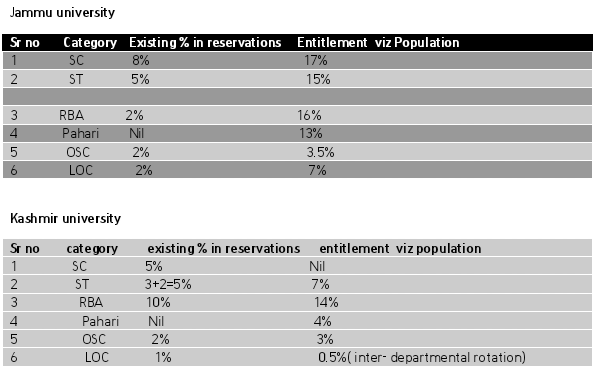
In the two UT Universities the admissions are restricted to the candidates of Colleges affiliated with them Which makes them effectively as regional universities but reservation policies followed lack logic as neither UT level nor Divisional level demography is represented in the reservations provided for. In national universities the percentage of reservations represents the national demography. Jawaher Lal Nehru University provides reservations @ 15% for SCs, 7.5 % STs and 27% OBCs corresponding to their respective proportional population in the Country. This stands generalized subsequently under Central Educational Institutions ( Reservation in Admission) Act 2007 applicable to all central educational institutions throughout the country. Since the UT universities cater regional Colleges therefore the reservations ought to be worked out on the basis of regional demography but the position is not so. Either the admissions should be open for all domiciled in the UT without any impediments including the factor of eligibility from the affiliated Colleges subject to the reservations applicable across the UT or in alternate in the context of Divisional stratification the reservations to correspond with demographic features of the Division concerned. The table below shall illustrate the stand point:-
The quota for Leh & Kargil Distts, Sports persons, NCC, NSS and others should subsist & wherever the reservations are likely to exceed 40% limit after accounting for 10% for EWS from 50% cap as seems to be the position in Jammu university the tool of reduction applied proportionately to all eligible categories.
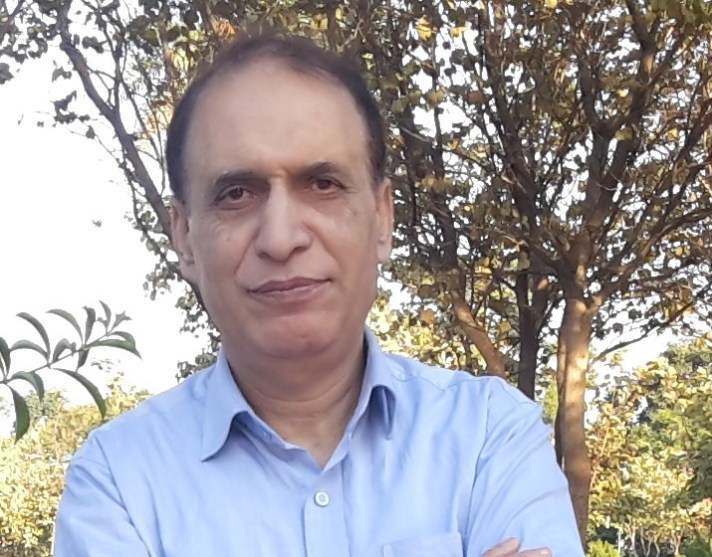
The Author is former Chairman JKPSC & can be reached on aaluzdeva_221256 @ymail.com.
Mining officials accompanied by robbers loot truckers
SNS KASHMIR
SRINAGAR, FEBRUARY 15:
Police in Awantipora today registered a case against District Minerals Officer (DMO), Kulgam and few private persons allegedly hired by some Mining contractors for extortion even as such cases are rampant in South Kashmir.
The case (FIR No. 21/2021 U/S 393, 341 and 506 IPC dated 13-02-2021) was registered in Police Station Awantipora in district Pulwama on a complaint lodged by Hilal Ahmad Reshi son of Ghulam Mohammad Reshi of Letpora. Reshi in his complaint alleged that the driver of his Dumper was robbed by District Minerals Officer Kulgam, Dr Khursheed Ahmad, and some private persons during the night intervening February 12 and 13 at Letpora in Pulwama district.
Reshi in his complaint said that his Dumper bearing registration number JK13B 7892 driven by Arif Bhat son of Mushtaq Ahmad Bhat of Letpora in Awantipora in district Pulwama was stopped by the officer at Letpora in Awantipora during the intervening night of February 12 and 13.
“These persons stopped few more vehicles including one more dumper bearing registration number JKO3F- 8885”, he writes in the compliant. Reshi stated that they beat up driver of his Dumper and one more driver Fayaz Ahmed Reshi of another vehicle. “They forcefully took away Rs 33, 000 cash and made him to transfer Rs 12, 000 to the account number 0200040100220195 belonging to one Amir Khan”, he stated.
“The two drivers were taken to a vehicle where they were beaten up by goons inside the vehicle and they were threatened of dire consequences”, read the complaint.
An official said that those involved in the case besides Dr Khursheed are Jamal Saif, Amir Khan and Ravi Gotam. The others who were with the officer for carrying out nocturnal extortion are being identified.
Inspector General of Police Kashmir, Vijay Kumar, told Excelsior that investigations are on and these persons will be arrested soon.
The DMO Kulgam told Excelsior that he has no knowledge about the case registered against him. Meanwhile, police tonight raided the office cum residence of one of the Mining Company at Bagat Srinagar but they had fled 15 minutes ago in a Bolero vehicle.
Sources said that it is a big mafia in South Kashmir where the Tipper and Dumper drivers are being looted by the officials and some goons who work for illegal mining mafia. These private persons had got mining lease in South Kashmir three years back and have managed extension of the lease but so far they have no allotment.
They said that mafia have hired goons who along with the Mineral Officers in South Kashmir are looting the truckers for carrying minerals during the night.
They said that as these truckers have to pay huge amounts of money to the mafia with the result the rates of minerals like sand, gravel and boulders have skyrocketed. They said that the administration is unmoved and are turning a blind eye towards rising prices of minerals.
They said that the rate of sand is Rs 10, 000 to Rs 13, 000 per 150 feet in Srinagar, the gravel between Rs 8000 to Rs 10, 000 when the rate of these two minerals was between Rs 5000 to Rs 6000 in 2018-19.(By Daily Excelsior)



You must be logged in to post a comment.